
Kenya has 77,716 schools, colleges and universities on the SchoolRegistry Kenya register, in all 47 counties. The official count from the Kenya National Bureau of Statistics (KNBS) is higher, at 93,988 schools in 2023. The difference comes from the age of the public lists the register is built from, which this article explains below. Every number here can be checked against the register itself, and each table says where its figures come from.
Source: SchoolRegistry Kenya register, 2026. Official total: KNBS Economic Survey, 2024.
How many schools are in Kenya?
The answer depends on what you count. The register counts every institution that appears on a public list: pre-primary centres, primary, junior and secondary schools, technical and vocational (TVET) colleges, teacher training colleges, Kenya Medical Training College (KMTC) campuses and universities. On that basis the total is 77,716.
KNBS publishes the official figure in its yearly Economic Survey. The 2024 edition reported that the number of schools rose by 4.9 percent to 93,988 in 2023. That total covers pre-primary, primary and secondary schools.
Source: KNBS Economic Survey, 2024.
So the two totals do not count exactly the same things. The register includes colleges and universities, which the KNBS school total does not. The KNBS total includes schools opened after 2016, which the public lists behind the register miss. The fairest comparison is level by level, further down this page.
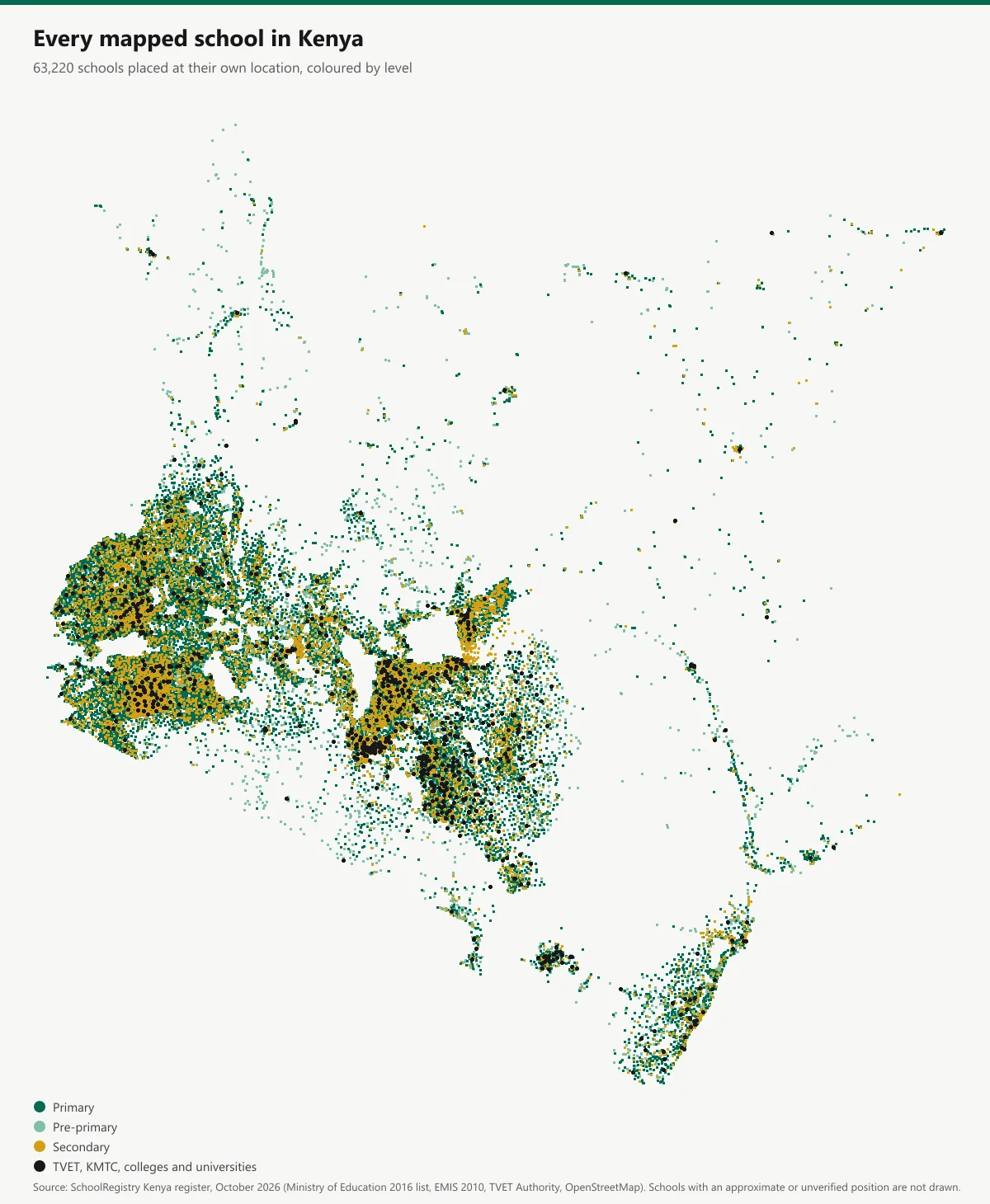
The map shows the shape of Kenyan schooling at a glance. Schools crowd the Lake Victoria basin, the western counties, the central highlands and the ring around Nairobi. Across Turkana, Marsabit, Wajir, Mandera and Garissa they thin out to lines along the roads and clusters around towns. The coast shows as a narrow band from Lamu to Kwale.
How many schools are there at each level?
Primary schools are the largest group, followed closely by pre-primary centres. Secondary schools are about a third as many as primary schools.
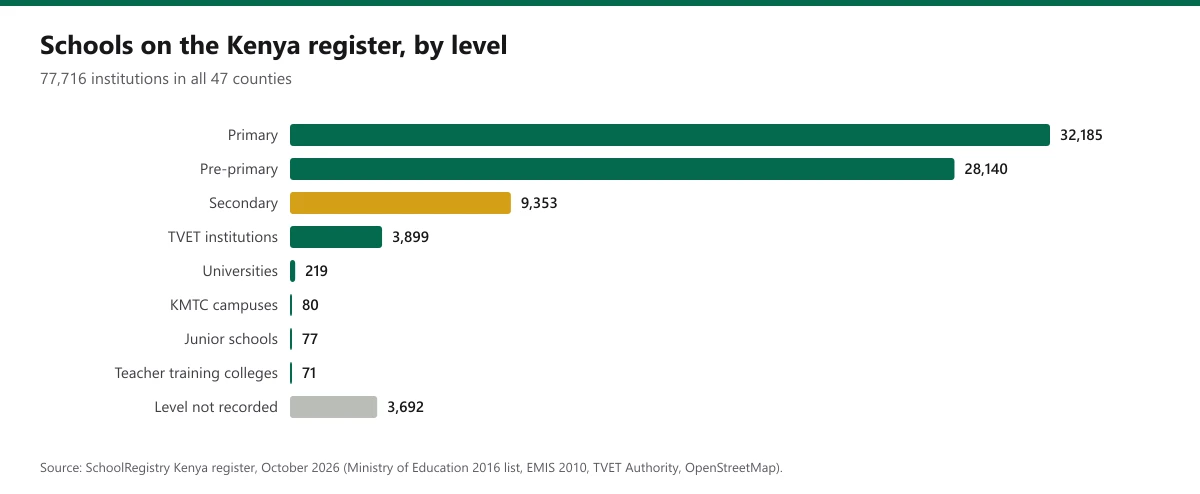
| Level | Institutions on the register |
|---|---|
| Primary | 32,185 |
| Pre-primary | 28,140 |
| Secondary | 9,353 |
| TVET institutions | 3,899 |
| Universities | 219 |
| KMTC campuses | 80 |
| Junior schools | 77 |
| Teacher training colleges | 71 |
| Level not recorded | 3,692 |
| Total | 77,716 |
Source: SchoolRegistry Kenya register, 2026.
Two things in this table need a note. Junior schools look rare, with only 77 listed. That is because Grade 7 to 9 classes mostly sit inside existing primary schools under the Competency-Based Curriculum, so the lists record the primary school, not a separate junior school. And pre-primary centres outnumber primary schools in 17 counties, including Nakuru, Uasin Gishu, Trans Nzoia and Kakamega. Many of those centres share a compound with a primary school but were registered as separate entries, so the count reflects how the lists were kept as much as how many buildings there are.
How many schools are public and how many are private?
Of the schools whose ownership is recorded, 51,024 are public and 22,056 are private. That makes about 30 percent private, or three in ten. Another 4,636 have no ownership recorded.
The private share changes sharply by level. It is highest in pre-primary and in TVET, and lowest in secondary school, where most places are in public schools.
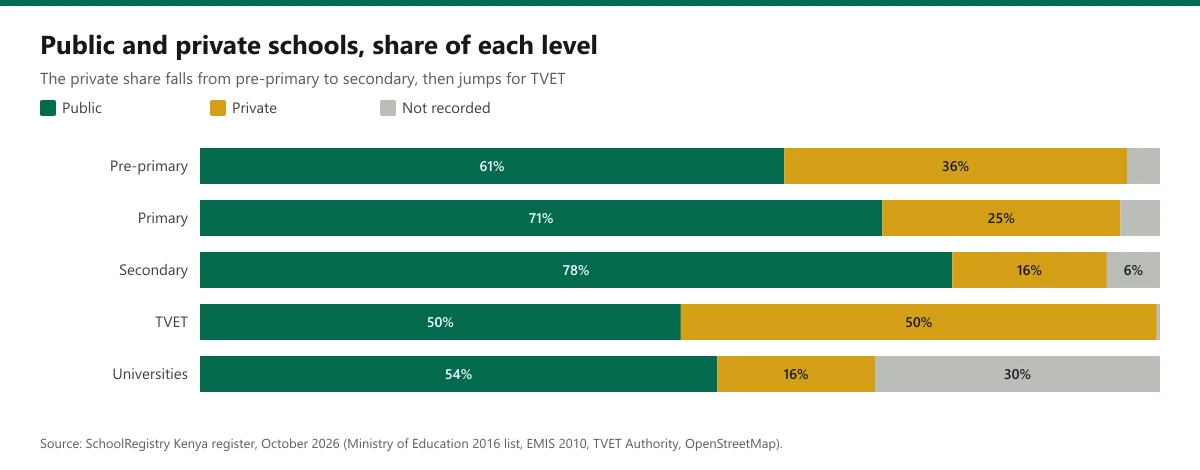
| Level | Public | Private | Not recorded | Private share |
|---|---|---|---|---|
| Pre-primary | 17,125 | 10,050 | 965 | 36% |
| Primary | 22,874 | 7,984 | 1,327 | 25% |
| Secondary | 7,329 | 1,507 | 517 | 16% |
| TVET | 1,953 | 1,933 | 13 | 50% |
| Universities | 118 | 36 | 65 | 16% |
Source: SchoolRegistry Kenya register, 2026. Shares are of all institutions at each level, including those with ownership not recorded.
For parents, the secondary figure is the one that matters most. Fewer than one secondary school in six on the register is private. Public secondary schools carry the system, which is why placement after the KJSEA and the cluster a school belongs to weigh so heavily on families. Private provision is strongest at the two ends: before primary school, and in technical and vocational training after it.
Which counties have the most schools?
Nairobi has the most, with 4,916 institutions, or 6.3 percent of the national register. Nakuru, Kakamega, Kisii and Kiambu follow. Together those five counties hold 17,401 institutions, more than a fifth of the total.
| Rank | County | Institutions | Secondary schools |
|---|---|---|---|
| 1 | Nairobi | 4,916 | 481 |
| 2 | Nakuru | 3,358 | 437 |
| 3 | Kakamega | 3,212 | 390 |
| 4 | Kisii | 3,000 | 467 |
| 5 | Kiambu | 2,915 | 430 |
| 6 | Meru | 2,772 | 372 |
| 7 | Kitui | 2,598 | 362 |
| 8 | Machakos | 2,548 | 321 |
| 9 | Bungoma | 2,513 | 329 |
| 10 | Homa Bay | 2,480 | 330 |
Source: SchoolRegistry Kenya register, 2026.
At the other end, five counties have fewer than 450 institutions each: Samburu (434), Wajir (412), Isiolo (323), Mandera (276) and Lamu (229). Most of these are large, dry and thinly populated, so fewer schools does not on its own mean fewer schools per child. Kisii stands out from the top five. It has fewer institutions than Nairobi or Nakuru but the second-highest number of secondary schools in the country, 467.
Where are private schools the majority?
In four counties, private schools outnumber public ones: Mombasa and Nairobi (82 percent private each), Kiambu (60 percent) and Nakuru (53 percent). All four are urban or peri-urban, with fast-growing populations and families who can pay fees. In much of rural Kenya the picture reverses. In Vihiga only 9 percent of schools are private, and in Makueni, Siaya, Samburu, Tana River and Elgeyo-Marakwet the share is 10 percent.
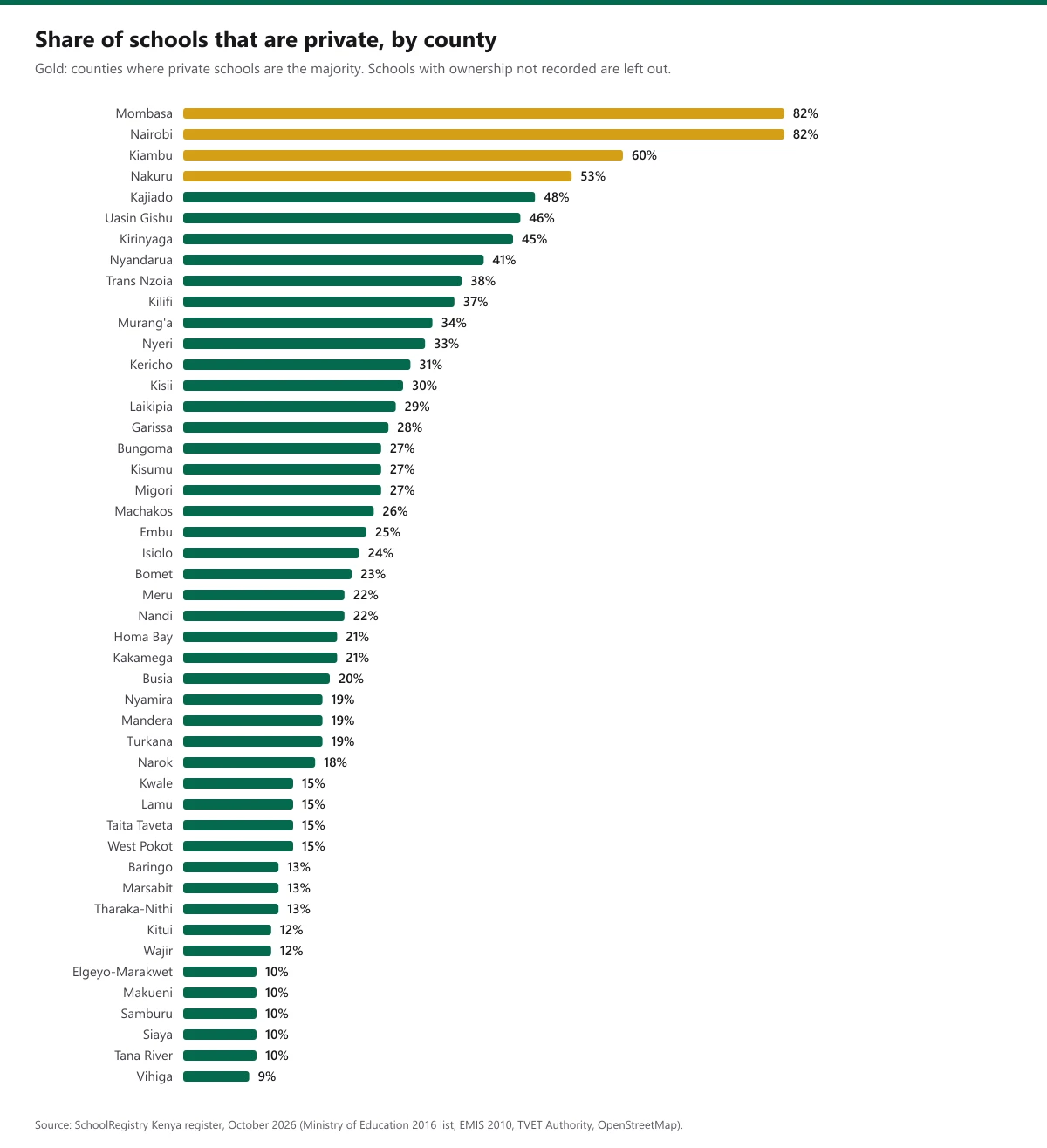
This split matters when you compare schools across counties. A family moving from Siaya to Nairobi goes from a county where nine schools in ten are public to one where four in five are private. Fees, class sizes and how schools are inspected differ a great deal between those two worlds.
Every county, in one table
The full count for all 47 counties, sorted by the number of institutions. The private share counts only schools whose ownership is recorded.
| County | Institutions | Primary | Secondary | Pre-primary | TVET | Private share |
|---|---|---|---|---|---|---|
| Nairobi | 4,916 | 1,662 | 481 | 1,128 | 580 | 82% |
| Nakuru | 3,358 | 1,040 | 437 | 1,612 | 173 | 53% |
| Kakamega | 3,212 | 1,262 | 390 | 1,383 | 121 | 21% |
| Kisii | 3,000 | 1,339 | 467 | 992 | 118 | 30% |
| Kiambu | 2,915 | 1,111 | 430 | 1,012 | 253 | 60% |
| Meru | 2,772 | 1,271 | 372 | 725 | 91 | 22% |
| Kitui | 2,598 | 1,143 | 362 | 849 | 144 | 12% |
| Machakos | 2,548 | 1,002 | 321 | 862 | 213 | 26% |
| Bungoma | 2,513 | 1,158 | 329 | 877 | 114 | 27% |
| Homa Bay | 2,480 | 1,278 | 330 | 757 | 61 | 21% |
| Makueni | 2,367 | 1,211 | 367 | 523 | 150 | 10% |
| Migori | 2,237 | 1,066 | 246 | 833 | 62 | 27% |
| Uasin Gishu | 2,222 | 824 | 216 | 1,019 | 127 | 46% |
| Bomet | 2,196 | 894 | 270 | 857 | 52 | 23% |
| Kisumu | 2,164 | 939 | 231 | 799 | 98 | 27% |
| Murang'a | 2,080 | 808 | 322 | 787 | 115 | 34% |
| Nandi | 2,050 | 809 | 197 | 944 | 43 | 22% |
| Siaya | 1,784 | 714 | 224 | 756 | 60 | 10% |
| Kilifi | 1,620 | 607 | 212 | 622 | 101 | 37% |
| Nyeri | 1,610 | 713 | 235 | 546 | 73 | 33% |
| Nyamira | 1,603 | 792 | 236 | 442 | 67 | 19% |
| Nyandarua | 1,560 | 538 | 229 | 692 | 42 | 41% |
| Trans Nzoia | 1,537 | 518 | 200 | 733 | 70 | 38% |
| Baringo | 1,528 | 648 | 170 | 560 | 32 | 13% |
| Narok | 1,504 | 680 | 121 | 604 | 27 | 18% |
| Vihiga | 1,496 | 613 | 166 | 627 | 53 | 9% |
| Kajiado | 1,487 | 580 | 141 | 622 | 98 | 48% |
| Kwale | 1,441 | 648 | 95 | 574 | 60 | 15% |
| Embu | 1,414 | 626 | 204 | 428 | 73 | 25% |
| Laikipia | 1,329 | 623 | 129 | 486 | 35 | 29% |
| Mombasa | 1,269 | 563 | 131 | 417 | 121 | 82% |
| Busia | 1,215 | 476 | 123 | 526 | 44 | 20% |
| Kericho | 1,176 | 629 | 184 | 285 | 51 | 31% |
| Tharaka-Nithi | 1,057 | 497 | 140 | 338 | 47 | 13% |
| Kirinyaga | 991 | 434 | 151 | 355 | 47 | 45% |
| Elgeyo-Marakwet | 922 | 405 | 98 | 345 | 31 | 10% |
| West Pokot | 910 | 355 | 81 | 393 | 24 | 15% |
| Turkana | 700 | 229 | 40 | 347 | 39 | 19% |
| Taita Taveta | 644 | 213 | 71 | 212 | 73 | 15% |
| Marsabit | 519 | 197 | 24 | 232 | 12 | 13% |
| Tana River | 493 | 190 | 25 | 235 | 13 | 10% |
| Garissa | 456 | 169 | 26 | 164 | 22 | 28% |
| Samburu | 434 | 153 | 18 | 244 | 12 | 10% |
| Wajir | 412 | 201 | 33 | 108 | 17 | 12% |
| Isiolo | 323 | 117 | 23 | 104 | 12 | 24% |
| Mandera | 276 | 125 | 34 | 80 | 16 | 19% |
| Lamu | 229 | 85 | 20 | 104 | 12 | 15% |
Source: SchoolRegistry Kenya register, 2026. A further 149 institutions have no county recorded. Each county's own page lists its schools by sub-county: start from schools by county.
How does the register compare with the official count?
Level by level, the register holds most of the schools KNBS counts. For primary schools it holds 32,185 against an official 35,570, which is 90 percent. For secondary schools it holds 9,353 against 10,752, which is 87 percent.
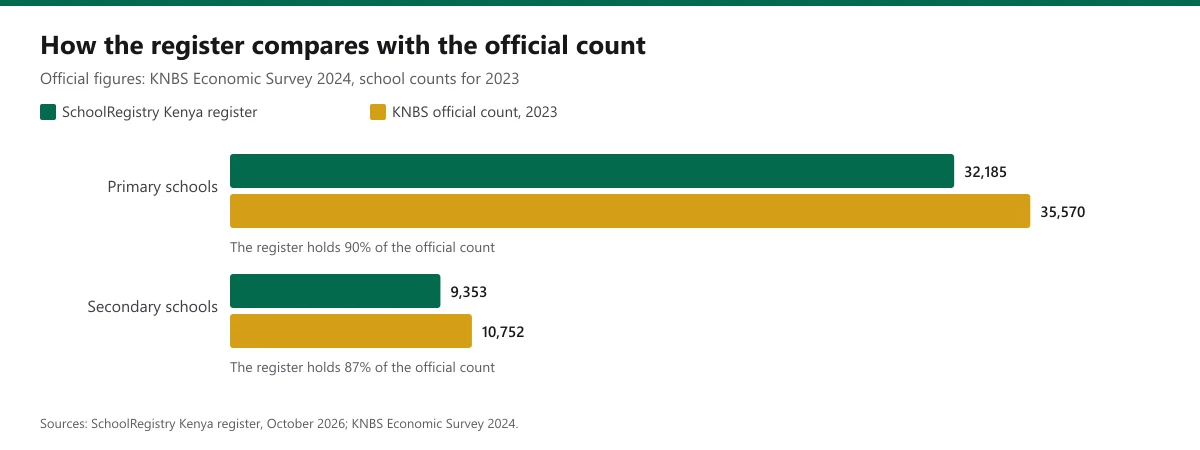
| Level | Register | KNBS official, 2023 | Register as share of official |
|---|---|---|---|
| Primary schools | 32,185 | 35,570 | 90% |
| of which public | 22,874 | 23,831 | 96% |
| of which private | 7,984 | 11,739 | 68% |
| Secondary schools | 9,353 | 10,752 | 87% |
| of which public | 7,329 | 9,485 | 77% |
| of which private | 1,507 | 1,267 | 119% |
Sources: SchoolRegistry Kenya register, 2026; official figures from the KNBS Economic Survey, 2024 as compiled by Stats Kenya.
The biggest gap is private primary schools: the register has about two thirds of the official number. That fits what we know about the lists. Low-fee private primary schools have opened quickly since 2016, the last year in the Ministry list behind the register, and many of them are missing. The register shows more private secondary schools than KNBS does, which most likely reflects schools recorded differently in the two sources, or schools that have since closed or changed ownership. We report both sets of figures rather than adjusting one to fit the other.
How we counted, and what the register misses
The register combines public lists, and each record keeps the list it came from:
- 36,022 records from the Ministry of Education's EMIS list of 2010
- 35,072 from the Ministry of Education school list of 2016
- 3,126 from the TVET Authority, and 263 from KUCCPS
- 3,098 from OpenStreetMap, and smaller sets from KMTC (80) and the Commission for University Education (55)
66,202 records, or 85 percent, are placed at the school's own location. The rest have an approximate position or none. The map above draws only the 63,220 schools with an exact location and a known level.
Source: SchoolRegistry Kenya methodology.
Three limits are worth knowing. First, the lists are old, so schools opened since 2016 are often missing, and some closed schools may still appear. Second, names and levels are as the lists recorded them, which is why pre-primary centres can appear separately from the primary school next door. Third, ownership is missing for 4,636 records. If your school is missing or wrong, the school can claim its page and correct it, or anyone can send a school we do not have.
Key figures to cite
- Kenya's school register (SchoolRegistry Kenya, October 2026): 77,716 institutions in 47 counties.
- Primary 32,185; pre-primary 28,140; secondary 9,353; TVET 3,899; universities 219; KMTC campuses 80; teacher training colleges 71.
- Public 51,024; private 22,056 (30 percent of those with ownership recorded).
- Most institutions: Nairobi 4,916. Fewest: Lamu 229.
- Highest private share: Nairobi and Mombasa, 82 percent. Lowest: Vihiga, 9 percent.
- Official KNBS total for 2023: 93,988 schools, including 35,570 primary and 10,752 secondary.
To cite this page: SchoolRegistry Kenya, "How many schools are in Kenya?", 25 October 2026, schoolregistrykenya.com/blog/how-many-schools-in-kenya.
Questions people ask
How many schools are in Kenya?
The SchoolRegistry Kenya register holds 77,716 schools, colleges and universities in all 47 counties. The official KNBS count of pre-primary, primary and secondary schools was 93,988 in 2023. The register includes colleges and universities but misses many schools opened since 2016.
How many secondary schools are in Kenya?
The register lists 9,353 secondary schools: 7,329 public, 1,507 private and 517 with ownership not recorded. KNBS counted 10,752 secondary schools in 2023, of which 9,485 were public and 1,267 private.
How many primary schools are in Kenya?
The register lists 32,185 primary schools, of which 22,874 are public and 7,984 private. KNBS counted 35,570 primary schools in 2023, with 23,831 public and 11,739 private.
Which county has the most schools in Kenya?
Nairobi, with 4,916 institutions on the register, followed by Nakuru (3,358), Kakamega (3,212), Kisii (3,000) and Kiambu (2,915). Lamu has the fewest, with 229.
How many private schools are there in Kenya?
The register lists 22,056 private institutions, about 30 percent of those whose ownership is recorded. Private schools are the majority in Nairobi, Mombasa, Kiambu and Nakuru.
How up to date are these numbers?
The register is built from Ministry of Education lists from 2010 and 2016, the TVET Authority, KUCCPS, KMTC, the Commission for University Education and OpenStreetMap, and was counted in October 2026. Schools opened since 2016 are often missing, which is why the official KNBS total is higher.